Sunday, 2 May 2010
09:50

Incas, In Cars and Incorrigible

Machu Picchu – The Lost City of The Incas

Hola faithful blog followers. Apologies for the lack of updates.

We spent a few good nights in Cusco getting our tourist on and mingling with the crème of public school gap yearers while awaiting the first available train to Machu Picchu. You don’t necessarily have to take a train, some people prefer to walk (The much publicised Inca trail) However, time constrained as we were, and much in need of the extra days relaxation, El treno won the vote. Particularly as it was not just any train, but the Inca Rail no less. Well ahead of their time those Incas.

Our evening train arrived in the modern Machu Picchu tourist Mecca in the late evening of the 8th, allowing us enough time to grab a bite to eat before catching some sleep. The modern Machu Picchu sits a 2 hour hike below the real Machu Picchu and our enthusiastic guide had told us we would need to leave at 4am to reach the lost city by sunrise. We duly arose as instructed and set off in the dark and rain, slightly too stupefied by the time of day to register how miserable the weather was. After completing the hard climb in only an hour and spending the next 60 minutes standing in the rain (we’re clearly too macho for our own good) we were rewarded by the most unremarkable sunrise you can imagine. The lost city of the Incas is hidden amongst a cloud forest, and along with being wetter than an otters pocket, the clouds are also quite the party poopers when trying to observe a sunrise. However, the additional advantage of being amongst the first 400 trekkers to the top each day is you then have the option of climbing one of the mountains that over look the city. Excellent, more climbing.


Our guide met us outside the main entrance (ie the touristy bit where they check you’ve paid rather than anything more Inca-esque) and, walking like blind men in the dense fog, led us to the outlying ruins. The tour lasted about 3 hours, roughly about the same time it took the burning Peruvian sun to lift the rain cloud above the city and reveal the absolutely majesty of Machu Picchu and it’s stunning setting, crowning the peak of a mountain with steep terraced slopes falling away to the churning white waters of the Urubamba river snaking along the valley floor. It really is one of the most breathtaking sights you can imagine. The mountains of Huayna Picchu and Machu Picchu (for which it was re-named, the original Inca name is unknown) stand like citadels either side of the city which is surrounded in all directions by jungle green peaks and valleys. It spectacularly underlines why those pesky Conquistadores had so much trouble trying to find it! And yet, the view struggles to compete with the city itself. The place is absolutely massive, dwarfing any other ruin we have ever seen.


As the weather had lifted during our tour we decided it would be worth climbing Huayna Picchu and taking a look at the city from above. It’s another tough climb up the original stone steps left by the Incas, and involves crawling through a small tunnel through the rocks and up steps that stick horizontally out of the rock face, with a fairly hefty drop beyond. On the way up you are rewarded with yet more ruins, as not content with Machu Picchu itself the Incas also built a temple for their oracle up here! The final 20 meters is an any which way you can scramble over massive boulders, and then you are at the summit with the morning sun blazing down and Machu Picchu spread out below you. It’s really not a bad view at all. In fact so much so that as we sat and took it all in an Argentinian guy next to us dropped onto one knee and (a little breathlessly) asked his girlfriend to marry him.


After climbing back down to Machu Picchu we ordered the worlds most expensive cheeseburgers and then spent a good few hours walking round (Okay okay, sorry girls. She said yes. All very happy. Round of applause from everyone at the summit. They even posed with my teddybear penguin and Tom may have caught some of the proposal on camera, which we promised to send to them. Go grab yourself some Kleenex and then read the rest of the blog).


The Inca civilisation was vast, stretching from modern northern Chile, across Bolivia and Peru and up into Ecuador. They had just shy of a 100 major cities however as the Spanish conquered their territories they razed each city to the ground and rebuilt and renamed them. (In bouts of nationalistic pride a lot of these cities are now being renamed). As Machu Picchu was not discovered until 1911 it stands as a living monument to all things Inca. Anyway, I think I’ve run out of superlatives for it so I’ll let Phil’s camera do the talking.


Lima

After another overnight drive from Cusco we arrived into the smoggy and much maligned Peruvian capital of Lima. Although we had been advised about the difficulties of driving through, we felt that having tackled La Paz at rush hour we were more than qualified. Unfortunately poor old Barry was still suffering from her salt flat mishap and decided that she wanted another new set of bearings for her other front wheel. Unfortunately she reached the decision while we were driving down the main freeway through Lima. Be a team player Barry. However our decision to buy a Toyota has definitely been a winner as, having limped to a slightly dodgy looking mechanics, they had little problem finding new parts and fixing it.


We decided to spend a few nights chilling out in Lima with a few friends we had been running into since La Paz. The city itself is not that much to speak of but we had a good couple of nights out, culminating in a Moby concert on the 15th which was excellent.


About an hour south of the Ecuadorian border is a little beach town called Mancora and after another overnight drive we reached it on arguably the most important day of the calendar year, April 17th. Since arriving in Peru we have been continually pestered by policeman who seem to view foreigners as a legitimate secondary income and we, not overly inclined to wasting our time or money or both, had decided to take the fairly comical action of simply not stopping every time we were waived down. This may sound a little dangerous but we think that at some time one of us may have read something somewhere on the internet that may well have stated something to insinuate that they probably wouldn’t bother to chase us, which seemed concrete enough (in fact have a gander at this blog for one appraisal of the integrity of Peruvian police). We decided not to be too blasé about it and every time a policeman waved us to stop, we simply smiled and waved back. The first couple of times were a little nerve-racking but as you can probably imagine it got pretty funny pretty quickly. Unfortunately a few hours shy of Mancora we probably overstepped the mark, having slowed to a near stop, indicated to pull in as directed, and then just driven off, again. 60 seconds later the flashing lights behind us indicated that a certain amount of music needed to be faced. We were prepared. “Why didn’t you stop?” said the policeman carrying an AK47. “Speak you the English?” we countered. “You were told to stop. Why didn’t you stop?” the second cop demanded. “Speak English amigo, speak English?” “Which country are you from” he shot back. “Englishy. You speak Englishy”. Phil was going for an Oscar by this point “You need to turn around and go back to the check point” He demanded, gesticulating furiously. “No problemo” Tom said, and handed him a receipt from the last toll gate we’d been through. (We’d decided that along with deliberately not understanding anything we’d uselessly offer stuff to appear helpful). It worked, unfined and most importantly unAK47’ed we were on our way.


Our hostel in Mancora would not have been out of place in the Costa del Sol with a plethora of pasty white English bodies crisping nicely by the pool, just in time for the “Baywatch” themed fancy dress party that evening. It was pretty much the best place I could hope to be to celebrate my 29th birthday. We’d also run in to an aussie couple in Lima and the guy shared the same birthday, so it wasn’t long before we were making heroes of ourselves dancing half naked on top of the bar. The next few days were spent chilling on the beach (never, ever let a girl talk you into going horse riding on the beach, they just hand you the reins and let you have a completely uncontrolled, ball-bustingly fun gallop) and Tom and Phil waxed off their boards and got all gnarly on me, apparently off in search of the ultimate ride.


Ecuador (as made famous by Sash)

Despite absolutely loving the 1997 dance track we had all decided that Ecuador would simply be somewhere we drove through en route to Colombia and most importantly Cartagena on the North coast, where we will inevitably spend at least a week trying to get Barry on a boat to Panama. Which meant that we rattled through pretty darn quickly. The Ecuador – Peru border had the dubious title of “The worst border crossing in South America” which predictably meant that we had no problems getting through. Well, except for actually finding the immigration building in Ecuador. Take a right at the roundabout if you want to go through customs, otherwise apparently just press on. Must make smuggling very tricky. We settled in Machala for our first night, which is pretty poor and scummy but at least the incredible humidity meant that we weren’t concerned by the lack of hot water in our hotel.


Colombia

Two more stops in Riobamba and Ibarra, which were both to be fair quite quaint, and we were on our way through the badlands to Colombia. South turned into north as we crossed the equator which lies just south of Ibarra. Actually, we crossed it twice due to the winding road but nonetheless it felt pretty cool now finding ourselves exactly half way round the Earth watching the GPS latitude count tick down to 0 then flip over to a northern scale. Thankfully, though, we've yet to come across men sporting flat caps, whippets on leads of bailing twine and saying "aye'oop," every now and again. And it certainly isn't grim! Onwards and upwards then to country number six... The Ecuador-Colombia border is one of those places the risk adverse foreign office website advises you not to travel through, so we set off at 6am to give ourselves a full days daylight as the one thing we didn’t fancy is cruising through FARC central at night. Although we probably did not spend enough time in Ecuador to give you a completely fair appraisal of it, one thing we can confidently say is that their road signs are absolutely useless and stand like a beacon of mediocrity amongst the rest of South America (which is saying something). Eventually though we reached the border and were instantly impressed by both the presence of the police and military in Colombia and their professionalism. We drove through a myriad of checkpoints on our way up to Popayan but happily they were more interested in doing their job than picking up a bribe. Once again the FCO scaremongering is being put to rest as we've made the call to take the western route up the country, passing through the previously notorious drug cartel hotspots of Cali and Medellin. Pablo Escobar and his cronies are now consigned to the annals of history (Escobar himself to a box six-feet under having been slotted by the police back in 1993 here in Medellin). Both cities are colourful, vibrant and very safe. As are the roads; the authorities are determined to ensure that visitors and locals alike can move around freely and without trepidation. Columbians are warm and welcoming and the country is one that we're all loving more by the minute.

We're just completing a few running repairs to Barry (the steering tie-rod has worked its way loose) before we tackle the next 650km to the Caribbean coast and the (reportedly) beautiful colonial town of Cartagena where we will pause to figure out the best way to get us all to Panama. A BBQ beckons this evening at our hostel. The sun is shining and I've just seen the fridge get restocked with the local brew. Happy times!

Thursday, 8 April 2010
11:53

The Death Road & Perusing Peru

So, back in La Paz and the ThisRoad team was reunited. La Paz was still as smoggy as ever, so in order to give our lungs a short respite we booked ourselves on a downhill mountain bike ride down the World's Most Dangerous Road - otherwise known as The Death Road. This turned out to be, as those kids with silly long blonde hair (or Phil) like to say, like totally awesome, dude! It was a descent of over 3km down 64km of road that claims an average of 300 lives per year. Nuts! We passed crosses on the way down at the spots where people have met untimely ends by plummeting, in some cases, 600m down a sheer vertical cliff-face into the jungle below. There was one point where a tractor pulling a cart with 95 people on board went over the edge. In 2006. Blimey!!


Suffice to say, hearts were racing slightly as we zoomed down this dry, dusty and stoney road (built by Paraguayan prisoners of war in the 1940s) and we were locked in concentration so as to avoid the edge where no hint of a barrier would save a slip up. What a rush!! And to put all our mother's minds at rest, we went with an extremely reputable company called Gravity so we were in extremely safe hands. Actually, this could be a new career move... Luckily the road was quiet so we didn't have much upcoming traffic to contend with, which was good as for the most part the road was only one vehicle-width wide. The other reason for this was because the following day was election day, so all the locals were going nuts about that in town. When we returned to the city we found that all bars were closed and not serving alcohol. Bummer! Apparently, Bolivians get very excited about elections and in the past would get totally tanked and go out for a spot of rioting. As you do. So the authorities ban booze the night before voting. Kinda goes to show how charismatic British politics is..! The two main backpacker hostels secretly kept their bars open so we were not to go dry on our last night in Bolivia. What a relief! Next on the agenda was to exit La Paz and make a break for the Peruvian border at Lake Titikaka. Now I don't want to come across as superior, elitist or anything like that, but I can see why the UK is such a great country. Road signs. We've got the whole signage thing nailed. It took us a bloody hour to figure out a way out of La Paz. Not one sign in sight giving any indication what road we were on, or where that road led to. A right pain in the backside! No wonder Bolivians are such pants drivers; they're all flippin lost! Our trusty GPS came to the rescue as we used the tried and tested method of navigating using compass alone. We wanted to go west (no outbursts of Pet Shop Boys warbling, please) so found roads that did that and by jove we ruddy well did it. Hurrah! The border crossing was another interesting experience and a classic example of IT not being the work efficiency saviour it is always touted as. Phil had to end up completing the electronic vehicle entry document on behalf of the somewhat befuddled (and senior in years) Peruvian official. We took the stamped up third attempted print-off and the smooth asphalt of Peru beckoned. Until said smooth asphalt gave up the ghost and became more pot-holled than a golf ball. Carry on into the night where headlights appear to be optional and we experienced an interesting drive to Puno, our stop-over on the drive north to Cusco.


And so we joined the thousands of other tourists that descend on the former Inca capital and Spanish colonial regional centre. In contrast to La Paz, Cusco is clean and fresh, with bright sunny plazas, stunning 16th century architecture and little back alleys populated with artisan shops and taverns. It also is crowded with peoples of all nations who flock to see arguably South America's biggest draw, Machu Picchu. In a vain attempt to get with the cool kids and be where it's at, we checked into Hostel Loki and instantly felt a generation apart. This place is full of gap-year backpackers, all wearing happy pants and llama jumpers, talking about how amazing traveling is, what uni they're off to come September and how no-one should need to, like, have to work or anything, all while never actually leaving the hostel bar (which, incidentally, is where I am typing this right now, having just watched Manchester United loose, sadly, to Bayern Munich on the widescreen. Pot, kettle, black, you say??!) Our plan to drive up to Machu Picchu have been scuppered for a variety of reasons and so we're hanging around here till the 8th when we catch a train for a 2-day visit to the ancient Inca ruins. To aid passing the time we volunteered to help clearing up some of the surrounding villages that had been devastated in the recent mudslides. Off we went with a few others from the hostel (Pauline, Tom, Don and Anya) to Taiy, a small village about an hour away where 120 homes have been wrecked of partially buried in mud. Phil went off to help dig out the ground floor of a old ladies house (by going in through the first floor) while Tim and I were tasked with commencing the demolition of a two-storey home with one of it's corners missing the mud-brick and plaster walls cracked and caving in and the roof being propped up with tree trunks. By hand. With no safety equipment or hard hats. And a ladder made from sticks. In an effort to rescue as much as possible, the roof tiles had to be removed individually and carefully so they can be reused. This took two hours perched upon a rickety building marked for demolition in the blistering sun. With a massive hangover. Yep, we got a little tipsy the night before. When will we learn? WIth the tiles down and stacked we attacked the rest of the roof. I must admit there is something decidedly counter-intuitave about removing something you are standing on that is stopping you from falling two stories to the ground. Well semi-stopping in Tim's case who half fell through, twice. The same hole both times; you'd think he'd have learned. Guess we used to call this sort of thing 'character building' back in the army. Bonkers if you ask me, but we persevered nonetheless and by close of play there was no roof to be seen. Other than the mass of detritus strewn around the base of the house. Tired, very dirty but satisfied we returned to he hostel where to cap off an otherwise fantastic day we won the bar-quiz!! Free shots and t-shirts all round! I'm off to join Phil and Tim on the pool table. Next post will be after Machu Picchu. Let's hope it lives up to the hype..!

Thursday, 1 April 2010
07:37

Let Me Tell You A Heart Warming Tale

Whilst Tim was away in New York for his brother's wedding, we headed on a detour south to the Bolivian salt-flats (Saltar de Uyuni). These, we were informed, were a must see. A classic tourist attraction, a number of agencies run trips from La Paz where tourists are bused south and hooked up with 4x4 tour operators in Uyuni who take them across the flats. We had a chat with one of these agencies to try to figure out their programs and the routes they take. Several routes dissecting the flats are mapped out and allow their traversing in various directions. We decided to head straight for the salt-flats, hitting them at the northern shore, rather than going to Uyuni on the east side first; a road less travelled, but what could go wrong?


Finally out of La Paz (possibly in the top 5 worst places on Earth by my book - the others include the centre of the Earth and a Kaiser Chiefs concert) we were able to enjoy some of Bolivia's amazing scenery. The approach to the flats took us through vast open spaces where the light is so bright you have to squint when wearing sunglasses, past huge meteor craters which hold blood-red waters, to eerily grey places as from some netherworld or post-apocalyptic vision, to valleys resembling good old Wales! As we made our way to the shores of the flats we picked our way past a volcano through deserted villages along bolder strewn tracks. Just as light was fading, from the crest of the pass, we were presented with the unforgettable and truly unbelievable sight of the Saltar's vast whiteness.


Darkness saw us reach our day's destination; the small village of Tagua. From here, the map told us, several routes spread out across the flats. We had planned to head out onto the flats to camp for the night. So that was what we did. The Baroness soon came to an abrupt stop and sat, up to her axles, in salt frosted mud. This was not good.

We tried to free the car and even after emptying it of all out kit (including the fridge!), letting down the tyres a little, digging and inserting the sandboards, we couldn't get it out. To add insult to injury, four local teenagers turned up on their push-bikes and asked "why did we get it stuck?". They then happily exclaimed that they would pick the car up and move it. It's a big car we pointed out. "No problem". Then to our utter amazement, they proceeded to show us an ingenious method for getting a car out of such a pickle. Using large rocks they gathered from somewhere out in the darkness, they created a firm base from which to jack-up the wheels (not the car), individually. They then dug under the wheels and inserted the sandboards and more rocks. Soon the wheels had something solid to grip. Although the car was still sitting on its underbelly, it was worth a shot. It worked! Reversing out of her near-grave Barry bounced back into life. We retraced our steps and set her on firm ground. The kids then told us that the way onto the flats was at the next village along. Turns out the map was wrong. There were two gateways onto the flats in the area; elsewhere the flats are quite soft around the edges. We turned in for the night incredibly relieved that the show would go on.


The following day, in our search for a safe route onto and across the salty wasteland, we stumbled upon a small museum curated by a rather cheerful man who gave us a guided tour. I'm not sure how many people had visited his museum since he told us most of his village had left and they never saw many tourists. This later predicament he was keen to see change. We're not sure what he had done so far to effect such a change although we suspected he had probably taken the usual Bolivian approach of just hoping; accurate maps and the use of clear signs would be a step in the right direction. Anyway, the museum was composed of two parts. One contained pots, grinding stones and stuffed animals. The other was a garden in which he had gathered rocks which looked like other things. Where those things didn't look quite enough like the things he thought they should, he doctored them. The garden also contained two human skeletons in a small rock tomb.


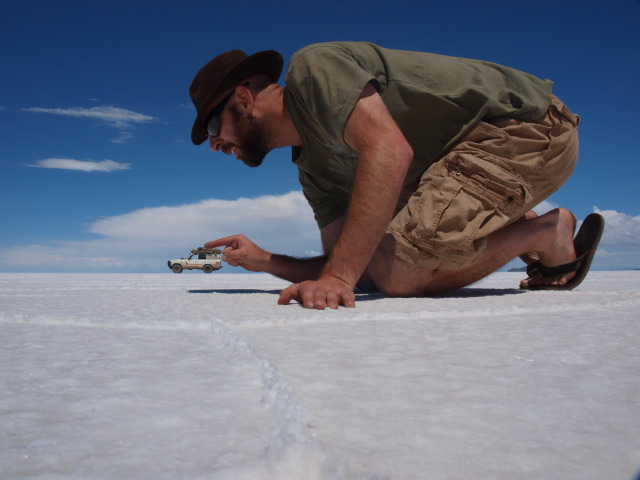
After our tour we were pointed in the direction of the entrance to the Saltar and off we went. What an utterly bizarre experience! The Saltar is huge (a good 3 hour drive across its width) and perfectly flat and the sensation of driving across it is not unlike flying through space as depicted in the likes of Star Wars; everything is coming towards you but you never seem to get anywhere.


The hard, crusted surface is covered in an irregular salt lattice (presumably from the evaporation process) which crunches under the wheels. Something else that crunches is the front left hub of your Landcruiser if you forget to take it out of 4-wheel-drive on the hard, crusted surface of the salt-flats. It's called 'wind-up', it's technical (email Tom for a full explanation if you have problems sleeping), and something's got to give.


The front left hub, possibly because it had had bearing problems before, was the weak link - it broke. We managed to get the car to Uyuni (after stopping off at Cactus Island) where a mechanic disassembled the hub by attacking it with various implements including an angle-grinder and installed a new one.


The garage kindly allowed us to do some of our own running repairs and servicing in their yard so we were off running about town trying to find various hardwear and auto-part shops. Again, Bolivia, signs (especially on the front of your shops) would be really useful; hiding your business is not good business. Finally, with Barry in an altogether better state (including a good clean) we headed back towards La Paz to find the third amigo.

07:00

Attitude at Altitude

Valle de Luna is so called because it looks like the surface of the moon. It is also hotter than the sun and at night affords the most spectacular stargazing on the planet.


En route to putting me on to a plane from La Paz to New York we had dropped in to San Pedro de Atacama to take in some of the spectacular scenery, and the final site on our hit list were the hot pools and geezers, a further 2000 meters above sea level and the highest in the world. At 2500 meters we barely noticed any effects of altitude but it was abundantly clear from the stark warnings from traveldoctor.co.uk that attempting to climb more than 300 meters a day from that altitude would invoke a brutal enviromental retribution. 3 hours later we had driven to the edge of the geezers with the plan of a nightime swim in the naturally heated pool while supping on Chilean vino and barbequed steak. Unfortunately, having driven Macbeth to an untimely death, the three Shakespearan witches had taken it upon themselves to prevent tourists from any such nightime chennanigans and we were reluctantly invited to spend the night in a dormitary at their outpost, 2k short of our destination. (Apparently the fact that these geezers shoot out boiling water is not condusive to nocturnal tourism - there is no light, we will die! Phil eloquently argued that our car had lights but unfortunately snakes, snails and indeed puppy dogs tails would not have moved them)


So, having thouroughly ignored the traveldoctor´s advice regarding Altitude Sickness, we commited the final atrocity of spending the night at 4300m. This was a bad choice. The next morning (to borrow another bit of army slang that is contaminating my vocabulary) we all felt utterly rats. The general consensus was to just get 5 minutes of the glorified kettles on film and then descend quicker than a cliff-dwelling lemming. Upsettingly when we got there it was an incredible sight to behold. Deserts (particular at that height) get a wee bit chilly at night, and the subsequent heat contrast spectacularly illuminates the huge jets of steam that each of the 20 or so geezers shoot into the air. This really should have been Tierra del Fuego (the land of fire), although considering our current physical state Phil was keener on The Valley of Death.


When we had left the witches cavern earlier that morning, the first bus loads of tourists had started to arrive and so, keen to avoid the crowds, we drove over to the naturally heated pool to have a quick swim to ourselves. At this point it was still absolutley freezing and, feeling like death with the prospect of stripping down to swimming trunks ahead of us, morale was hitting an all time low. Luckily ThisRoad is made of sterner stuff, or more accurately we are all shameless exhibitionists in front of the camera. To be fair the swim was very pleasant if slightly unnerving. Rather than having a uniform temperature the gratifyingly steaming pool is a turbantly mix of cold currents to make you shiver and bursts of heated water that thankfully fall just short of scalding. Filming done we hurriedly dressed into every bit of warm kit we owned and pointed Barry down the mountain to the oxygen rich oases below. Admittedly not quite soon enough for my vaulting stomach, another lesson in altitude awareness.


Our final destination in Chile before heading over to Bolivia was the northern coastal town of Arica. Its a surfers paradise and although we had no time to experience it, the follicly challenged of our group were reliable informed by our Point Break wannabe, uberman companion that the surf was excellent. The next morning we began the long ascent to the Chilean Bolivian border, a mere 5000 meters above sea level (where we had probably lost any of the acclimatisation from the Atacama the night before!) Barry, as utterly inescapely perfect-in-every-way as she is, is not the best climber, particularly when struggling to burn diesel in the oxygen depleted air, so we spent much of the journey crawling along at 20 miles an hour.


We arrived at the Bolivian border and were greeted by utter third world chaos, not entirely welcome at the best of times but even less so when breathable air had been reduced to 40 percent plus car fumes. We spent an hour trooping back and forth between different offices, trying to work out the order of stamps, photocopies, signatures, counter-signatures and tickets each utterly unhelpful "official" required. Finally everyone was satisfied and we drove to the exit gate, only to be told that our right hand car was not allowed into Bolivia. Fortunately just before our sense of humour failures began to register on the Richter scale Tom produced his International driving licence and blagged the guy into believing this meant our car could go anywhere we were allowed to drive in. It was quite obviously unashamed rubbish but the military-clad muppet waved us on, clearly content that he had dilligently defended his country´s borders.


Now for the exciting part. After our previous altitude idiocy we had decided to camp in the lower plains (as indicated on our oh-so reliable Bolivian map) before driving up to La Paz, which stands around 4000 meters. Unfortunately from our border crossing at 500m to La Paz 300 kilometers away, we never dropped below 3800 meters. Which meant that we may as well stay in La Paz and hopefully not be too badly affected. We reached La Paz after nightfall which was by no means a good idea. Never in our lives have we experienced such incredibly chaotic driving conditions. It is a complete an utter free-for-all where cars and pedestrians, many carrying babies on their backs, compete for every conceivable inch of space to force their way forward. As we approached what we thought to be the centre, using our GPS as a guide, I congratulated Tom on the almost miraculous feet of not having hit anything. He smiled appreciatively. The driver of the car we crashed into was amiable enough, and having been directed by a traffic cop to a relatively safe place to pull over I agreed to pay him 8 US dollars for his broken tail light (we barely touched him but Barrys illegal Roo bars take no prisoners) However the dilligent traffic cop, obviously keen to ensure fairplay, decided that about 30 pounds worth of Bolivian Dollars would be a more appropriate remuneration. A cynical person may be inclined to summise that not all of that was going to the driver, we however held no such opinion. At least the cop gave us some proper directions and we finally learned a crucial fact about La Paz that is a huge benefit to navigating around it. It is absolutely massive and the city centre is 400 meters below the high point to which you enter (Actually named El Alto). As we finally cleared La Paz part 1 we could see sprawling benath us and absolutely breathtaking view of the second plateau below us, effectively a second city just as big as the first. And finally our maps made sense as up until then we had driven nearly 8kms through a city without a single road being on our map!


Having checked into our hotel we headed out for a quick bite to eat, and, at the advice of the hotel receptionist who definitely used the word commission while making our reservation, enjoyed our first ever llama dinner. The restaurant proprietor had warmly greeted us and, though he had to shoot off before our meal was over, promised us a free "snake schnapps" and unlimited access to the salad bar to welcome us to his restaurant. And on top of that I have to say that Llama is actually really good and definitely one of the better meals weve had on our travels. As promised the waiter brought over our free shot at the end of the meal, the bottle he carried covered by a cloth, no doubt to preserve the liquors intensity. Now, even if you havent worked behind a bar I am sure you are all aware that various drinks are not necessarilly named for their contents. Sex on the beach for instance is happily not a mix of sand and, well you get the drift. So when the proprietor had said snake schnapps earlier I hadnt completely prepared myself for the waiter to wip off the bottle covering cloth to reveal a goddamn boa constrictor staring 4 inches from my inadvisable inquisitive face. The other two may have delighted in the fact that I recoiled quicker than a cocktail bound cobra but seriously, who expects to be served that? The baby boa was sat, immersed in schnapps with its head bobbing from side to side as the waiter poured out 3 shots. Cheers.

06:40

The Big Push North

One of the major aspects of this trip is the deliberate lack of timetabling where possible. We like to decide on the hoof where and when to go to next and how long we spend there once we arrive. Obviously we're following the Pan-Am, but little impromptu diversions and excursions here and there are all part and parcel of what makes this trip, well, this road. A combination of these, unavoidable holdups and general tardiness meant that the one deadline we did have to meet was fast approaching. Tim had to catch a plane from La Paz in Bolivia on the 25th so he could make his brother's wedding in New York, before returning to La Paz. Quite a distance to cover in a short time. Not impossible but we certainly needed to get our skates on. First stop, Chile's capital city.


In contrast to Conception, Santiago appeared far less affected by the earthquake. By the time we arrived it was hard to determine what was recent damage and what was existing decay. All in all Santiago felt very western and first-world as far as western cities blessed with a warm climate feel first-world; sunshine (and smog) cover a multitude of sins. We spent a day in Santiago and then left town in the evening with the aim of knocking out a 24-hour drive in order to eat up a serious chunk of the mileage to La Paz. Fuel tanks full we pointed ourselves north once more and set off into the inhospitable Atacama Desert. Despite our lights conking out (faulty relay) in the dark, in the fog, in the middle of nowhere, we made good progress.


Tired and grubby we nosed our way through the narrow streets of the little tourist oasis of (another) San Pedro, bang in the heart of the second-driest place on earth. Even though it hasn't rained here since records began, the Gobi Desert, north of the Himalayan mountain range (every day's a school day!) holds the title of world's driest place. Apparently. Anyhoo, we pitched camp and the next day took time out to explore the desert. And what a desert it is. Millennia of erosion and land-shifts have sculpted the salt, gems and nitrate encrusted land into weird and wonderful mountains, valleys and flats. The Valle De La Luna does indeed look like a moonscape and much fun was had speeding around, getting our Buzz Lightyear on!